Fatemeh N. Nokabadi

Machine Learning Scientist | Computer Vision, VLMs & Video Understanding

Fatemeh N. Nokabadi

I am a Machine Learning Scientist with over a decade of experience in computer vision and machine learning. I hold a Ph.D. in Electrical Engineering from Université Laval, where I conducted my doctoral research in collaboration with Mila – Quebec AI Institute, under the supervision of Prof. Christian Gagné and Prof. Jean-François Lalonde.

My work spans video understanding, object detection and tracking, model robustness, and multimodal vision-language models. I enjoy bridging research and practical applications, developing models and learning systems that are both effective and reliable.

Currently, I work at Employment and Social Development Canada, focusing on multimodal AI and document intelligence, including fine-tuning vision-language and recognition models for privacy-sensitive applications.

My research has been published in venues including TMLR and CRV, and presented at NeurIPS and ICML. I am particularly interested in advancing applied AI, exploring emerging technologies, and turning challenging research problems into practical solutions.

Expertise

Video Understanding & Detection Multimodal GenAI & VLMs Adversarial Robustness Privacy-Preserving Synthetic Data Efficient Real-Time Vision PyTorch & Hugging Face

Multimodal Models for Document Understanding

ESDCVision-Language ModelsDocument AIFine-tuningSynthetic Data
  • Led model development for a domain-specific visual document-understanding system based on vision-language models (VLMs), from dataset design and model architecture through training and evaluation.
  • Fine-tuned open-weight models from the Qwen-VL family and TrOCR using Hugging Face Transformers, integrating them into an existing multi-model recognition pipeline.
  • Designed field-level prompting strategies for VLMs after diagnosing hallucinations under whole-document prompting.
  • Co-designed custom loss functions tailored to the data distribution, improving recognition of French accented characters.
  • Built a synthetic data generation system with automatic annotation, removing the need to manually label privacy-sensitive material.
  • Trained YOLO object detectors to localize handwritten regions and attached objects in scanned documents for a downstream recognition stage.
  • Worked under strict privacy requirements and limited compute in an offline environment, with training pipelines on Azure ML.
Robustness Evaluation of Vision Models

TMLR 2024CRV 2025NeurIPS 2024Adversarial MLObject TrackingVision Transformers
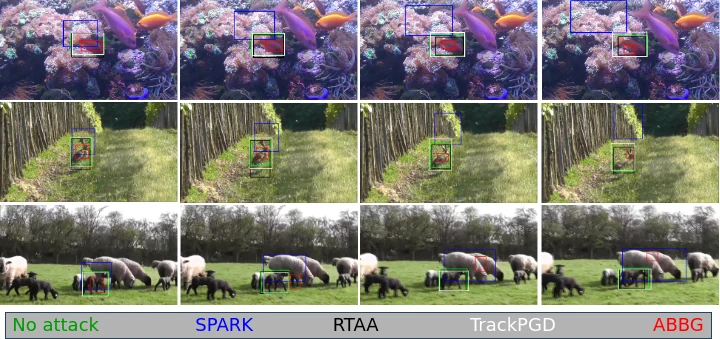
Tracker outputs on three video sequences with no attack and under the SPARK, RTAA, TrackPGD and ABBG attacks
  • Stress-tested state-of-the-art transformer trackers (MixFormer, OSTrack, TransT-M, ROMTrack, RTS) on GOT-10k, VOT2022 and UAV123 with white-box attacks that operate through predicted bounding boxes and segmentation masks.
  • Proposed ABBG, a single-bounding-box attack that remains effective across transformer trackers where prior methods fail.
  • Introduced TrackPGD, a white-box attack built on an object-binary-mask proxy that applies to mask-based trackers earlier attacks could not target.
  • Led a systematic reproducibility study across attacks, tracker architectures and perturbation budgets, awarded the TMLR Reproducibility Certification.
  • Investigated diffusion-based adversarial purification for video, characterizing the temporal-consistency limits of frame-wise approaches.

Representation Learning for Video Understanding

WiML @ ICML 2024Representation LearningReinforcement LearningVideo Tracking
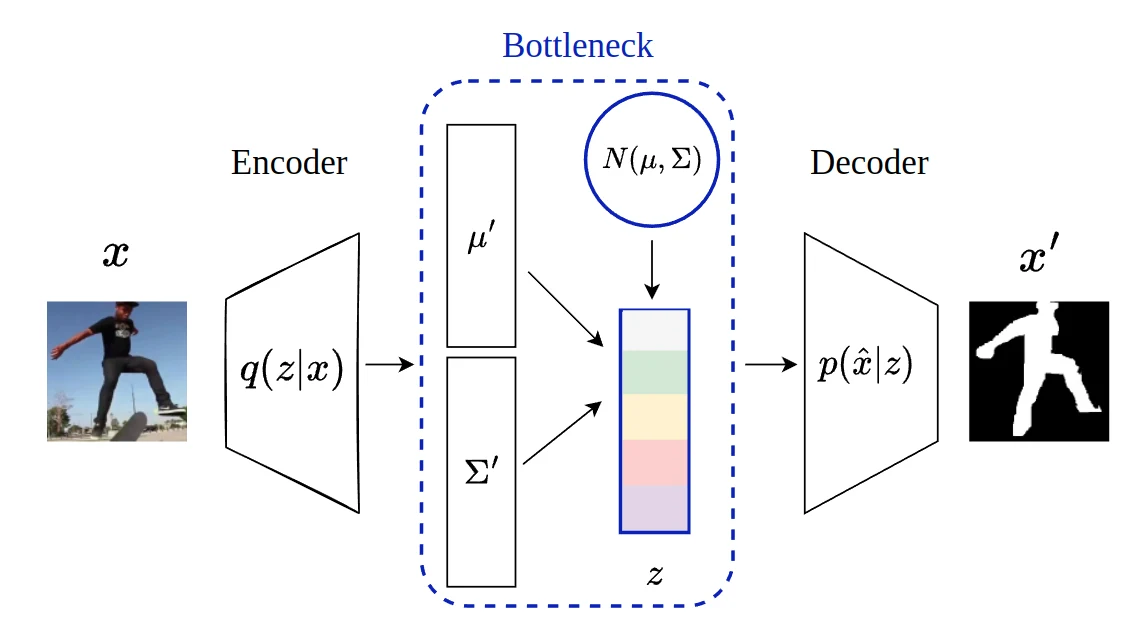
Beta-Multivariational Autoencoder: encoder, multivariate Gaussian bottleneck and mask decoder
  • Framed single-object tracking as a reinforcement-learning episodic task with a Soft-Actor-Critic agent learning a motion policy from video frames.
  • Proposed the β-Multivariational Autoencoder (βMVAE) and a U-Net variant (βMVUNet) to learn an entangled Multivariate Gaussian prior (mean vector and covariance matrix) over the tracker's correlated motion parameters directly from frame patches.
  • Jointly trained the decoder to predict the target's binary segmentation mask, so a single network learns the motion distribution and the per-frame object mask used by the tracker.
  • Avoided the posterior collapse that flow-based baselines (RealNVP, IAF, planar and radial flows) showed on the same data.
  • Curated a custom single-object tracking dataset derived from YouTube-VOS.

Visual Authentication System

ORIGYN FoundationFine-grained RecognitionVerificationAWS
  • Built computer vision pipelines for luxury product authentication, combining wavelet-based signal features with learned texture and micro-detail models.
  • Leveraged subtle visual cues for fine-grained authenticity verification.
  • Automated model-integration CI/CD on AWS to shorten deployment time.

Shoe-Size Matching Prototype

Technologie Intelligence ImageInstance SegmentationMask R-CNN
  • Prototyped the computer vision backend for a planned shoe-size-matching mobile app, using Mask R-CNN foot segmentation.
  • Provided recommendations on data collection and on optimizing inference for future integration into the app.

Graph-Based Salient Object Detection

MTAP 2018SIVP 2018SPIS 2015Saliency DetectionGraph Methods
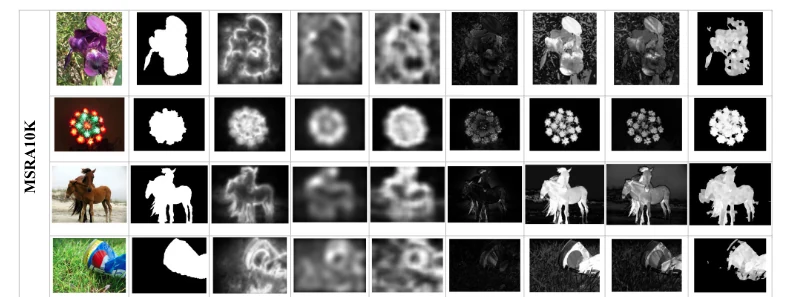
Saliency maps on MSRA10K images from the local, global and high-contrast graph method
  • Developed graph-based saliency detection algorithms using local, global, and mixed feature representations.
  • Proposed multiple methods including random graph and global contrast graph approaches for salient object detection in images.
  • The multi-graph approach outperformed state-of-the-art unsupervised methods on MSRA10K, SED2 and ECSSD.

Real-Time Multi-Object Tracking for Moving Cameras

Multi-Object TrackingReal-TimeC++ / OpenCV
  • Researched and implemented real-time multi-object tracking algorithms for cluttered video frames, incorporating salient object detection to prioritize targets.
  • Designed a MATLAB and C++ tracking system using OpenCV for moving-camera video streams, using quaternion Fourier transform-based saliency to speed up tracking through algorithmic redesign rather than extra compute.

2025

Adversarial robustness of learning-based single object trackers
Fatemeh Nourilenjan Nokabadi

Ph.D. Thesis · Université Laval / Mila · 2025

TrackPGD: Efficient Adversarial Attack using Object Binary Masks against Robust Transformer Trackers
Fatemeh Nourilenjan Nokabadi, Yann Batiste Pequignot, Jean-François Lalonde, Christian Gagné

22nd Conference on Robots and Vision (CRV) 2025

2024

Reproducibility Study on Adversarial Attacks Against Robust Transformer Trackers
Fatemeh Nourilenjan Nokabadi, Jean-François Lalonde, Christian Gagné

Transactions on Machine Learning Research (TMLR) · Reproducibility Certification

TrackPGD: Efficient Adversarial Attack using Object Binary Masks against Robust Transformer Trackers
Fatemeh Nourilenjan Nokabadi, Yann Batiste Pequignot, Jean-François Lalonde, Christian Gagné

Third Workshop on New Frontiers in Adversarial Machine Learning (AdvML-Frontiers) @ NeurIPS 2024

Adversarial Bounding Boxes Generation (ABBG) Attack against Visual Object Trackers
Fatemeh Nourilenjan Nokabadi, Jean-François Lalonde, Christian Gagné

Third Workshop on New Frontiers in Adversarial Machine Learning (AdvML-Frontiers) @ NeurIPS 2024

β-Multivariational Autoencoder for Entangled Representation Learning in Video Frames
Fatemeh Nourilenjan Nokabadi, Setareh Rezaee Oshternian

Women in Machine Learning Workshop (WiML) @ ICML 2024

2023

β-Multivariational Autoencoder for Entangled Representation Learning in Video Frames
Fatemeh Nourilenjan Nokabadi, Robert Bergevin

SSRN Scholarly Paper · Preprint

2018

Salient object detection method using random graph
Fatemeh Nouri, Kamran Kazemi, Habibollah Danyali

Multimedia Tools and Applications, vol. 77(19), pp. 24681–24699

Salient object detection using local, global and high contrast graphs
Fatemeh Nouri, Kamran Kazemi, Habibollah Danyali

Signal, Image and Video Processing, vol. 12(4), pp. 659–667

2015

Salient object detection via global contrast graph
Fatemeh Nouri, Kamran Kazemi, Habibollah Danyali

Signal Processing and Intelligent Systems Conference (SPIS), pp. 159–163

  • Peer Reviewer – BMVC 2026, CVPR 2025, Transactions on Machine Learning Research (TMLR), Springer Nature
  • Teaching & Mentoring – Taught and mentored students in C/C++ Programming, Image Processing, Stochastic Processes and Digital Communications at Shiraz University of Technology

Awards & Honors

  • 2024TMLR Reproducibility CertificationML Reproducibility Challenge 2023; presented at NeurIPS 2024
  • 2022REPARTI–FRQNT Scholarship
  • 2021Adobe Research FellowshipShortlisted among the top 30 candidates worldwide and interviewed
  • 2021CIFAR Deep Learning + Reinforcement Learning Summer SchoolSelected participant; organized by CIFAR with Mila, Vector Institute and Amii
  • 2021Otis-Lalonde Scholarship in Computer VisionUniversité Laval
  • 2016M.Sc. Thesis ScholarshipCognitive Science & Technologies Council

Talks

  • 2026Data Day 2026, ESDCPresented the team’s vision and document-intelligence work
  • 2026AI Infrastructure for Agentic SystemsSeminar for the ESDC data science team, synthesizing insights from the Agentic AI Summit (UC Berkeley)SlidesPlaylist
  • 2024NeurIPS 2024Reproducibility Study (journal-to-conference track), TrackPGD and ABBG (AdvML-Frontiers workshop)
  • 20154th Basic and Clinical Neuroscience Congress (BCNC)Oral presentation, “Graph-based salient object detection using color and edge features”